Why Bracket 4?
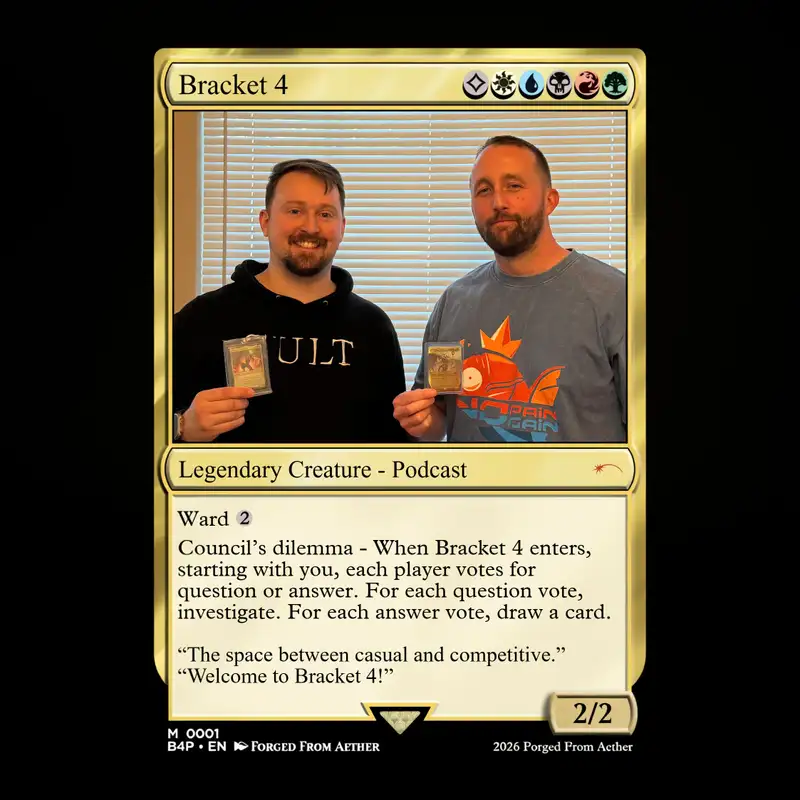
Welcome everyone to Forge from Aether. My name is Will. Today joining me will be your cohost, Aiden. Hello. You're joining us on the Bracket four podcast.
Speaker 1:So today, I just wanna basically introduce ourselves and talk a lot about Bracket four, what the what the podcast is going to be about and what to look forward to, and then we're gonna kinda get into what Bracket four means to us today. Aiden, why don't you go ahead and introduce yourself and tell us a little bit about what you know, who you are and what why is Bracket 4 exciting, and tell us about your magic history and background.
Speaker 2:Yeah. So my name is Adrian, one of the cohosts for the Bracket 4 prod podcast. Kinda got my start in magic way back 2005, 2006, I think. I was about 10 or 11 years old. Started playing as before commander existed, so commander wasn't really a constructed format as it is nowadays.
Speaker 2:But started in, I wanna say, like, eighth or ninth edition. It's around that time frame. But, essentially, started playing the game, grew up in a playing with some of my dad's friends, my dad as well. Then I took a break for a little bit of time in my early teenage years, and then picked it back up in my late teens, definitely early twenties, especially when commander had started becoming its own constructed format. Built my first commander decks.
Speaker 2:It always kinda started out as something that was a little, like, less powerful, more for the fun of the game, or trying to figure out what combinations I can make, especially with the limited format as it is. And then it has evolved into building decks towards a true reason, which Bracket four, I think, kind of lends itself to not feeling as meta as c e d h can, but definitely lets you get a little bit more creative with your win conditions and build towards a cohesive and well run deck.
Speaker 1:Awesome. Thank you so much for that introduction. And, yeah, I think we're gonna get into that a lot today talking about, you know, what is Bracket 4? Why do we play it? But, anyways, let me go ahead and introduce myself.
Speaker 1:My name is Will. I'm the host of Bracket four podcast brought to you by Ord from Aether. And, you know, just wanna kinda give you guys a heads up about my background. I've been playing magic just about as long as you have, Aiden. I believe my first set was seventh edition, and I believe one of the cards I remember from that was thorn elemental in Invisidrex, which I believe we'll talk about later.
Speaker 1:But not to outdate myself, but just wanted to mention that I've also been playing the game for a very long time. So today, really, getting back on track of, you know, what we're going to be focusing our conversation on, We wanna really talk about what is Bracket 4 commander. What is it like? Why do we play it? But, also, before we get into that, I just wanna kinda give you guys a heads up.
Speaker 1:You know, why should you be tuning into this podcast moving forward? It's because if if this feels like this is your niche, this is where you exist, then this is the place for you because we're gonna be talking about powerful decks. We're gonna be talking about, you know, different play styles. We're gonna be talking about optimized play. We'll be talking about deck building, interaction, nostalgia, power creep, and all the things that we kinda experience in this bracket.
Speaker 1:This is very much just of our perspective on it, and we feel like we've been playing the game for a very long time. So we hope that you will find some value out of it. That that's really what our goal is. So, really, what we're going to try and do today is we're gonna try and explain, like, what is Bracket 4? What is some of the power creep that we've experienced?
Speaker 1:We wanna talk about, you know, old versus new perspectives. We wanna talk about deck building, and we wanna talk about how how is Bracket four with other Brackets. So these are all kinda, like, topics of conversation that you'll hear us talk about throughout the season. But today, what I really wanna focus on is, like, what is Bracket four? So how like, main questions.
Speaker 1:How would we describe Bracket four in our own words? What should someone expect when they sit down at a bracket four table? What really separates bracket four from bracket three or maybe bracket four from CDH? And so those are kind of the opening questions. Aiden, I'm gonna pass it off to you.
Speaker 1:What are your thoughts on some of this?
Speaker 2:So in terms of, like, kind of what Bracket four is, I think it's definitely something where you're gonna sit down at a table with a lot of very fine tuned decks. People have stepped away from maybe the funny themes and gone more towards the effective strategies to win the game. It's not gonna be as aggressive as a cEDH deck where it's gonna be built upon meta pieces that are everybody else is using in that color scheme. Just, you know, trying to get as quick of a turn three wins. But it it definitely, I think, is built upon just maximizing every single card that goes into your deck.
Speaker 2:So for example, I got my cloud deck started off as a precon commander deck, and then I've upgraded it over time to turn it into a very effective Voltron commander deck that goes infinite with combats. It's a little bit predictable, so people have some heads up in terms of what's happening. So it's not like the game's over once they get started, but it's definitely a challenging deck to compete with. But I think I think Bracket four is a fun, lighter competitive format as well. It gives everybody an opportunity to win some games where it doesn't feel like there's only one deck or one type of meta.
Speaker 2:You know? Like, we're into Thassa's Oracle type of situations in cEDH where it just turns into everybody's building that style of deck because that's what wins. Now we can see a lot more like, we have, I think, collectively in the group over a 150 decks, somewhere in the neighborhood of that. And so there's a lot of good variety.
Speaker 1:That's a really good perspective. And I I think I have a I share a similar one. I would say that when you're sitting down at a Bracket four table, what should you expect? You're expecting, like, three other people that wanna win this game. Okay?
Speaker 1:That's that's the first thing that I wanna just, like, clear the air on. Like, these are like, if we say we're playing a bracket for deck, it means, like, we wanna win this game, but it also means, like, we might not have the money to make a c d h level deck. But in a Bracket four world, you're also expecting that pretty much all of these cards are real. Like, I've spent time and effort collecting these cards. I've gone out of my way to kinda, like, build this deck from scratch.
Speaker 1:I've playtested a bunch. I know what it's going to do, and I am trying to win this game. And I expect, like, every card is real. I expect that I'm gonna win the game, and I'm gonna win the game relatively quickly. I'm not gonna win it on turn two or three, right, which is what you might see at a CDH level, but I think I'm going to win it between turns four and six.
Speaker 1:And I'm not holding back. I'm playing all the game changers if I see fit, like, if they make sense in the colors or the commander that I'm playing. And, again, like you said, I think what that ultimately creates is there's a lot of variety. You said we have about a 150 decks in our in our playgroup. I'd say that's accurate.
Speaker 1:I'd say the amount of Bracket four decks that we actually see, probably 20 to 30, and they are wild. And I think the the crazy thing is is, like, with a with a bracket five deck, you know exactly what to expect. Right? You're looking for the Thos' Oracle. You're looking for for that combo.
Speaker 1:You're looking for the underworld breach. You're looking for, you know, the force of will. You're you're kinda, like, trying to fish for these cards that you know are gonna either be in your hand, in your deck, or in your opponent's hands or decks. In Bracket four, you don't know what to expect. You don't really fully like, you you might have an idea that there's a card that's like a combo piece, but you're not sure.
Speaker 1:Think of one of the decks I really like to point out is like Masrick. Masoric is very it has I'm trying to make it a Bracket four deck, but it has a lot of cards that aren't typically known to be combo pieces. And one of the cards that I'd like to point out is Scurry Oak. And Scurry Oak says, like, whenever one or more one or one one counters are put on Scurry Oak, you may create a one one green squirrel creature token. Mazdrick says that if you if a player sacrifices a permanent, put a one one counter on each creature you control.
Speaker 1:So that that kinda combo can go infinite where if you can if you have a sacrifice outlet, you're putting the counter on Scurry Oak. Scurry Oak's creating the creature, and then, like, you just go infinite. There's a lot of, like, weird interactions like that in Bracket four that just, like, all of a sudden, during four or five, somebody just kinda, like, presents this combo to you and and they win the game. So I I I guess, like, what what like, for those opening questions, how do would we describe it? And, know, what what makes it different and what to expect?
Speaker 1:I think those are all kinda questions I I touched on. I would say that, you know, in a Bracket three game, I think you're expecting for the game to go on a little bit longer. I think with a Bracket three deck, you're like, oh, I, you know, I can play some ramp. I can kinda just chill. Everyone's just gonna kinda do their own thing.
Speaker 1:No one's going infinite. In Bracket four, I don't think that's the case. And in Bracket five, I think they take it to a whole new level. So I think we're somewhere in between those two mediums, And that's kinda why this bracket exists, and that's kinda like why we play. So speaking about why we play, I mean, this is kinda like the heart of the episode.
Speaker 1:So what makes this bracket appealing? Why do you, like you know, what powerful cards do you see in the bracket, Aiden? What are some decks that you think are really cool, whether it's your own or maybe some of your friends, or what decks don't really work, what decks do, what kind of decisions have to be made. Talk about maybe some of the more complex board states and things, you know, problems that you had to think through. Talk about interaction and how it plays a role in this bracket, and talk about how maybe even, like, the politics at Bracket 4.
Speaker 1:Like, what are they like? Especially knowing that you and I typically play with the same group of people, how do you kinda navigate those scenarios with your friends? And talk about, like, winning. Like, you know, the what does it feel like to win with a Bracket four deck compared to maybe some of your others? These are all things that I really wanna discuss today on the on this podcast.
Speaker 1:Why Bracket four?
Speaker 2:Yeah. So I guess to kinda touch on towards the end of what you're saying with, like, the you know, maybe taking a little bit longer in Bracket three, you're chilling, everything like that. Bracket four definitely, I think, is built more upon faster games. And so, ultimately, you're able to play more games in the same amount of time that you would in, like, a bracket two or bracket three type of situation. It doesn't feel as bad as bracket five.
Speaker 2:You have a little bit more time to think on your feet based on what you have in your hand. But, you know, going into deck building, in our playgroup specifically, I think we're definitely heavier on the creature or, you know, combat damage type of decks in that bracket four range. We definitely have some outliers in terms of, like, Noren, for example, is a good one. Marik's a good one. Balrog's a little bit different where they do, like, kind of alternative damage or alternative win cons.
Speaker 2:But I think overall, in terms of when you're building a deck for Bracket four, you're really just building towards the strategy of, like, how can I overtake my opponents? How can I put stuff down, like my commander, for example, without it being able to be countered or killed instantaneously? So that way, I can have a chance to put my combo together, whatever it be, whether it's equipping your creature and swinging out for big damage or going infinite like you talked about with, you know, a loop or turning into, you know, you pay a bunch of life and cast all the cards off the top of your your library until you find, you know, your combo pieces and then, you know, kill everybody with direct damage or something. I think the most unique deck that we have probably in the bracket four range, I would argue, is gonna be your six card deck. I think six cards is definitely something that, like, when you first played it and brought it out, I was like, what are you talking about?
Speaker 2:A secret commander? You're you're searching for all these cards, and then all of a sudden, everybody's library is exiled all at the same time, and now we're on a a very, very, very limited timer. And it really just makes you think about, like, what you're doing on each of your turns before you do something. I love it because, obviously, it it hits you too, and so it's fair. It's super fair in terms of what it does.
Speaker 2:People have an opportunity to do something to you before you have the potential to win the game, which is really cool. But, yeah, I think I think we're very heavy in the direct damage or combat damage type of situation. I mean, we got Cloud. We got Jetmir. We got Othari.
Speaker 2:All those are really, really cool different kind of ways to do it. But ultimately, yeah, I think it's I think it's a fun it's a fun concept of how we have it. I think we're building more towards taking old decks that we also have in the playgroup around that 150. I know you said we have, like, 20 or 30 maybe that are Bracket four currently. People are making changes, though, because people like to win.
Speaker 2:I think winning feels good. Just trying to touch on everything that you were talking about and, you know, the tee up.
Speaker 1:Yeah. No. I I know I hit you with a lot of questions. And one thing I wanna kinda, like, circle back to is, you know, if if I were to ask you today to kinda build a Bracket 4 deck, why don't you walk people through kinda, like, what that process looks like? And, you know, one of the things I really want you to touch on is, like, how do you factor in cost versus, like, effectiveness versus, like, being able to combo out, being able to control your opponents.
Speaker 1:Like, where is the value in in Bracket four for you? Like, how do you really think about deck building? Like, if if I was like, man, you know, like, build a Bracket four deck today that that's gonna do or die. Right? Like, it it's a tournament.
Speaker 1:You're gonna win a bunch of money. Well, how what is your thought process right now? Like, how does that go?
Speaker 2:So to start off, I I always start my deck building around, obviously, what the commander is. Right? So it has to do something that pushes your game along. Doesn't necessarily have to affect everybody else's game in the same way, but you wanna have it to be I always go back to Cloud, but Cloud does a lot of things. Right?
Speaker 2:Cloud draws me cards. Cloud has haste. Cloud equipped something. Cloud makes me treasures. Like, there's multiple things that happen all on one card for five mana.
Speaker 2:Do you a lot of opportunity to build around different pieces of synergy in that deck? So I start with the commander. Once I decide kind of what my commander is, obviously, you gotta have the staples. You gotta have mana rocks. I usually like to stick around 36 to 38 lands for my deck.
Speaker 2:I think that's the kind of the sweet spot area for me. I don't like to go any lower because I think you're too lean at that point. You're not gonna see a lot of land, especially if you get into multiple colors. My preference is three colors or less if I'm building a commander deck. I think number one, if you're getting into building Bracket four, one to two colors or, you know, three colors even gives you a little bit more safety, like, if you don't pay attention to the ratio, and so you'll see a lot more land comparatively.
Speaker 2:But you're gonna want, like, mana rocks. I usually shoot for anywhere from eight to 12 mana rocks in my deck. Staples like, you know, arcane signet, soul ring. After you get through the mana rocks, I focus on protection. So protection leans into my creatures, my artifacts, my enchantments need protection.
Speaker 2:I'd say more often than not, it's gonna be creatures or artifacts rather than enchantments. Your commander is the big piece, obviously, for the strategy. So having stuff to protect him. So equipment may be, like, that gives him hexproof or some sort of spell that allows you to deflect. I like deflecting SWAT.
Speaker 2:It is a little bit more of a pricey card, but it's a it's a really good card in red for diverting somebody's attack on you, maybe something where you can give them a clever concealment. You can phase them out, stuff like that. So I usually do around six to eight pieces of protection. Removal. Removal is gonna be big.
Speaker 2:So you're gonna want a lot of removal because while you're trying to build your board state, other people are also trying to build their board state. And so you're gonna wanna interact with them. Case in point, if, you know, you try to run out with a combo, I have to have something to remove the the crux of that combo. And so if I don't remove that, I lose the game. And so to be able to have that up in my hand, path to exile is a good one.
Speaker 2:Go for the throat. That's a great one. Love to see that one come out. So once you get past the rocks, the mana base, the removal, and the protection, you know, you're left with, like, maybe 30 to 45 slots of cards left depending on how you have it lay layered out. I just build it full tilt into whatever my theme is.
Speaker 2:So let's say dragons or dragon. It's common commander for five colored dragons. You're gonna build it into combo dragons. Dragons that boost up your other dragons' attack power when they attack or dragons that when they enter, they deal damage to other to opponents based on the number of dragons you control. If you sideshift into something like a Voltron commander, you're gonna wanna build it around equipment combo pieces, less creatures.
Speaker 2:So you're gonna build it into, hey. How many artifact equipments can I get to boost my commander's efficacy when he swings and does combat damage? He needs to be able to get through, so he's unblockable. He needs to be able to deal a ton of damage and deal commander damage that's lethal. Let's boost up his power and toughness.
Speaker 2:It really just focuses in on just running away with the theme of what the commander is. Sounds very repetitive, but, ultimately, that's what it is.
Speaker 1:I agree. Like, and and you've done a great job describing it. And I I think I just kinda wanna leave you with before I get into my take, what have you noticed yourself gravitating towards if somebody asks you to play a bracket four deck? You know, what are the the first decks first three decks that you would think of? Why do you think of them?
Speaker 1:What makes them a good deck? What what defines that for you? Why do you feel comfortable playing them? Just talk about that a little bit more.
Speaker 2:So for me, I have I would say OG Partners, Cloud, and Kratos. So OG Partners is so back in the day, what, 2016, I think, when they did the original commander commander set. I don't even I guess that was the official title of it. They released a bunch of precon commanders. I think it was five of them.
Speaker 2:Commander decks, I should say. They released five of them that were various different colors, themes, whatever, and they introduced what was called the partner mechanic. So the partner mechanic means that you can have two commanders as long as they both have the the word or the keyword partner on it. Nowadays, they've obviously edited that a little bit to where it's like, you know, partners with somebody instead of it being, you know, just
Speaker 1:Friends forever.
Speaker 2:Yeah. Friends forever. They got survivor. I think they did on the last of us secret lair, like stuff like that. Ultimately, it's all variants of partner.
Speaker 2:Partner itself, though, when they first released it with the commander 2016 was multicolored commanders. So they had several different two color commanders. My partner deck, which is a combo deck at its roots, is a is Bruce Tarl, Boris Herder, and Ikra Shadiki, the Usurper. So it's everything but blue is the color scheme. So it gives me access to four different colors, lots of really good cards.
Speaker 2:I built it upon comboing Bolas' Citadel. So it's it's a life gain deck at its core, and then the life is used as a resource to be able to basically burn through my deck with various different cards. So let me pull up the deck list real quick, and I'll kinda go through some of the combo pieces for you guys.
Speaker 1:Don't forget Heliod because Heliod is the freaking problem, dude.
Speaker 2:Heliod is really good. Definitely. I'd say it's definitely a problem.
Speaker 1:But yeah. Then, I mean, you have, like, aether flex reservoir. Right? Right? And so, like, I know that there are tons of ways where I've seen you kinda gain infinite life, and I'm like, oh, okay.
Speaker 1:Like, he has infinite life. I'll come within factor. I'll mill him or something. But then you're like, no, dude. Like, the game's over because, like, aether flex reservoir or, like you said, There are ways that you're gonna u utilize that life as a resource to just kinda end the game.
Speaker 2:Like, the combo pieces, for example. So Archangel of Thune, which says flying lifelink whenever you gain life, put a plus one plus one counter on each creature you control, and then you go ahead and hit it up with spike feeder. Basically, it's a it's a three drop creature. So it's two green, one colorless, zero zero. It comes into play with two plus one plus one counters.
Speaker 2:Then you can pay two, remove a plus one plus one counter from it, put a plus one plus one counter on target creature. Don't care about that. All we care about is remove a plus one plus one counter from spike feeder, you gain two life. Then because it combos with archangel of thune, whenever you gain a life, you put a plus one plus one counter on a creature. Then those alternate back and forth.
Speaker 2:You gain a billion life, and now your life is whatever resource you want it to be. Aetherflux reservoir, like you said, top 50 life, boom, you're dead. Boom, you're dead. Boom, you're dead. Instant speed, game over.
Speaker 2:Doesn't matter.
Speaker 1:Yep. Yep. Really fun
Speaker 2:deck to play, really complicated in terms of getting the pieces. So if it's really about mulliganing, getting your
Speaker 1:Yeah. I mean, a lot a lot of your early game just looks like, okay. Like, I'm searching for these things, and then, like, also, I'm leaving up a mana to make sure you don't do the thing. And then I'm also ramping. So, like yeah.
Speaker 1:No. It's it's a really well put together deck. Talk about Kratos and the other one, Cloud.
Speaker 2:Yeah. So Kratos Kratos is a really cool secret lair drop. One of my favorite game IPs of all time is God of War. So I was super stoked whenever they revealed that, my PlayStation secret lair. But Kratos is a three drop mono red.
Speaker 2:So he's three red to cast. He's a two three. He has double strike. All creatures have haste. And then at the beginning of each player's end step, Kratos deals damage to that player equal to the number of creatures that player controls that didn't attack this turn.
Speaker 2:So I really built it upon just blasting through cards. So if I don't have the cards I want, I have ways to cycle my hand, discard, and then draw cards, or draw cards and discard, or wheel of fortune type of mechanics. And then I also built it around big creatures and then doubling or tripling damage. Some cool cards for that, like dictated the twin gods, faded firepower. That's from the avatar set that came out recently.
Speaker 2:That one's really cool because you can pump a ton of mana into it on a turn, and then all of a sudden, the damage goes up exponentially. The cool thing about him too is it doesn't matter if they could or could not attack. So if they have summoning sickness and they're like, oh, I couldn't attack with it, Doesn't matter. If you didn't attack with it, you're taking the damage. And so it really incentivizes people to swing, so it speeds up the game a lot.
Speaker 2:He's a very difficult deck to pilot, though, ultimately, because of the fact that, like, everybody now becomes like, they they start to panic a little bit because now they feel like there's a lot more pressure of, like, if I'm playing creatures, I know they're gonna have haste. I know I'm gonna take damage if I don't attack with them. Now I gotta figure out who I'm swinging at. And so the game can people can start beating on me just because, you know, now they have the ability to. And so it's about thinking about your turns each time.
Speaker 2:Most of my wins have come from just straight up mobbing the board with a bunch of creatures. So trying to build it up as quick as possible with the amount of creatures I have, and then hoping that people aren't swinging at me on each of their turns. Lastly, we'll come to Cloud. Cloud's my my baby boy. I love that deck.
Speaker 2:Final Fantasy is definitely something that I've I've enjoyed over the years as, like, a game itself, but I never I would say I never was, like, a super fan. But the magic of the gathering set, obviously, was a really cool concept to me, and they did a great job with just fantastic cards all around. Every card in that set was just amazing. So I ended up building my first ever Voltron commander with Cloud. So I bought the precon.
Speaker 2:I said, you know, f it. Let's let's invest some money into some equipments. Not really my normal concept for a deck. Normally, it's creature based or plus and plus one counters or hydras or something stupid. Right?
Speaker 2:Like, built a ton of those. But ultimately, I ended up building it off the precon. Started off, play tested it a couple times just straight out the box. I think I played, like, two or three games. Loved the concept.
Speaker 2:Really fun. Then I went full tilt into it, invested a ton of money and time and effort into adding those protection that I the protection pieces I talked about, the removal pieces I talked about, and then adding in a bunch of, like, infinite combats combos in there. Multiples that way redundancy. You know, somebody removes one of my pieces, I still have opportunities to still win the game with that same setup. But ultimately, Cloud just gets it going, bro.
Speaker 2:So Cloud reads, he's a five color commander. He's two colorless, one red, one green, one white. He's a four four when he enters. He has haste, so he can attack on the turn he enters. When he enters, you attach up to one target equipment you control to it.
Speaker 2:So any equipment you have on the battlefield already, boom, slaps right onto him. And then whenever he attacks, you draw a card for each equipped creature attacking you control. Then if he has seven or more power, you create two treasure tokens. So you get immediate payoff from him just by the fact that he can swing right when he comes in. Then you also get free equipment cost.
Speaker 2:So let's say you got, you know, buster sword out. Boom. Slap his sword on. Now he's seven power. You're gonna get the ability of whatever hits with the buster sword, Plus, you're gonna get to draw a card, so you get to hopefully put some sort of answer in your hand if you're looking for one.
Speaker 2:And then you get to create two treasures. So if you still have some mana up two treasures, now you can play something else on your second main phase. He's an amazing commander. The biggest one that I have in there is gonna be Aurelia and Sword of Hearth and Home, and then a few different combo pieces and aggravated assault. So, like, Bear Umbra, Feast and Famine, Seaborne Muse.
Speaker 2:Once you have the mana going, you just have infinite combats because every time you just untap all your lands, retap your lands, redo aggravated assaults, and then aggravated assaults is gonna be a three drop enchantment. You pay five, two red, three colorless, and then you can untap all creatures you control. If it's a main phase, so you get first or second main phase, there's an additional combat phase followed by an additional main phase. Activate only as a sorcery. So every time you go through a combat, you end.
Speaker 2:You've untapped all your things with Bear Umbra, Feast and Famine, or Seaborne Muse as they state, and then pay for it again, swing out again.
Speaker 1:Ridiculous.
Speaker 2:Yeah. Of those decks, though, the three the three decks that I listed, OG Partners is the strongest deck I have followed by Cloud then by Kratos. I actually kill myself with Kratos more more often than I win with Kratos, but it's always a gamble with that one.
Speaker 1:Yeah. So thank you for breaking those down, and I think that's super interesting. Definitely gonna just touch on some of these points. You know? Like, I would say I I would just like to kinda echo some of the things that you pointed out, you know, when when we're deck building.
Speaker 1:Some of the things that we think about in Bracket four is, like, how do we stop our opponents? And I think you'll see a lot of one man and targeted removal, But you'll see a lot of those powerful cards still. I think that we definitely very much like to optimize our decks. I think that, like, we'd like to go back, and we and the fun thing about our our pod is, like, sure. We might start with a Bracket two, and it might become a Bracket three.
Speaker 1:And one day, it might even become a Bracket four depending on how much time and effort we we put into it. And it definitely sounds like with your Cloud Deck, it definitely started out as a precon, turned into Bracket three, and then over time, turned into a Bracket four. I think it's very hard and and fun to balance those complex board states that I was talking about. Right? Like, you might not even know like, you might not even realize that Scurry Oak is a combo piece in a deck, but it is.
Speaker 1:And it when you're at a bracket for table, I think you pay a lot more attention to, like, oh, okay. Like, would you play? Oh, I I haven't heard of that card. Like, what does that card do? Yeah.
Speaker 1:Right? Because, like, if you don't know what that card does and it does something that's gonna, like, actually combo out, then the game's over. So, like, I just think that that type of interaction's really important. And I the last point I wanna touch on is kinda, like, something that has been kind of up for debate in our pod. It's like, you know, this whole discussion about proxies versus nonproxies.
Speaker 1:I think one of the things about Bracket four that everyone's very prideful on is that when you finally feel like you have a Bracket four deck, it feels like you've you've earned it. Right? You know, you've thought about, you've played the deck enough, you know what cards need to be in that deck, and then you've gone out of your way to collect them, and they're there. And you just feel so satisfied by that. So after you've done all that work and you're sitting at a Bracket four table, like, if you win, you win.
Speaker 1:If you lose, you lose. Like, at the end of the day, that's fine. But when you feel like somebody has a card that maybe shouldn't be at that table and some of the cards that really come to mind are the cards that you would see at the cEDH table, like a guy's cradle or, you know, some of these any of the dual ends. Right? Like, immediately, any card that's, like, over $500, you're like, did did you really like, is that is that card actually yours?
Speaker 1:And so I think that's kinda where Bracket four draws its sign. It's like, okay. Cool. You have a really powerful deck, but, like, do you actually own that deck? And I think that's kinda one of the differentiators between a Bracket four and a Bracket three deck, and that's kinda like the next topic is talking about playing to win versus playing only to win.
Speaker 1:So, like, in Bracket four, we if if we bust out a Bracket four deck, it actually has some consequences. Consequences. And let's talk about that a little bit because I don't know if it does in other playgroups. Right? Because in our playgroup, we track our stats.
Speaker 1:Like, at the end of the day, we don't we don't obsess about them, and we've had that conversation, and it's taken some time for us to get on that same page.
Speaker 2:For sure.
Speaker 1:But at the end of the day, we we do track the stats, and we do care about our deck stats. Right? If I bring out a Bracket four and everyone's like, whatever, and everyone gangs up on me, I'm gonna be upset about it because I wanna win with that Bracket four deck versus maybe any of my other decks. Like, if we all showed up with Bracket three decks, I'm like, okay. Whatever happens happens.
Speaker 1:So so talk about a little bit how Bracket and the Playgroup app plays into the playgroup and into Bracket four ultimately for us.
Speaker 2:We use a playgroup app called playgroup.gg. Shout out to the creators of that. But we've been using it for, well, I wanna say almost two years now consistently. So very good amount of time for utilizing the app. They added a feature, I wanna say towards the end of last year, we could split it up into different groupings for how it tracks and then still keep your overall tracking as well.
Speaker 2:So, like, we have a 2026 year for our tracking. That way, we can look at the stats year over year. But, ultimately, yeah, I think initially well, I think before we stepped into the Bracket four realm, like, consistently, we used the app. We were tracking games, and I think, you know, it was a fun little competitive thing. And then I think it started getting someone saw their stats, you know, maybe adjust or, you know, somebody step ahead of them.
Speaker 2:And so then they're like, okay. Cool. Well, I don't like him being ahead of me on the tracker, so I'm gonna build a little bit of a better deck. Well, then, you know, this person's now doing better. So then the next person's like, oh, I don't like them doing better than me.
Speaker 2:And so it started this, like, arms race almost of everybody compounding their their decision making process into, like, just funneling all their time and energy into building better and better and better decks. And then we ended up with, at the end of last year, it was just out of hand where people were, you know, going week over week, talking about, oh, you won two games last week. Your your ranking is way higher. We're all gonna gang up on you now and and take you down a couple notches. That way, your ranking drops.
Speaker 2:And I think we kind of took a step back, realized, number one, we love the the competitiveness of Bracket four, and so the the kind of deck building insight that we gained from building towards cohesive strategy. Then we took a step back to, like, realize, like, well, the fun of the game isn't necessarily always winning. It's also having a good time with your friends. And so I think we adjusted the way we react to people winning the game, I think. And so now we don't focus solely on the person that won the previous game with whatever deck they have because don't like the fact that they won a game.
Speaker 2:And now it's more of, like, threat assessment based on what's actually the threat. So who's who's taking the game to the next level each turn? We should focus on stopping them trying to win the game ourselves.
Speaker 1:Right. It's this competitive balance of, like, playing with playing to win versus playing to only win.
Speaker 2:Yeah.
Speaker 1:Right? And I think that there's a lot of people in our playgroup that wanna be able to play a deck regardless of the other people's power level and feel welcomed at the table. And I think we also wanna promote that environment at the same time. Right? Like, somebody shouldn't be bad like, feel bad because they wanna play an ally stack or a shrine stack.
Speaker 2:Or a werewolf stack.
Speaker 1:A werewolf's deck. Yeah. Exactly. But, like, at the same time, like, it it's just this really kinda hard balance that I think we consciously take into effect. Right?
Speaker 1:Like, it so two of the decks I'll just briefly touch on. Like, right, I have a Celeste combo deck, and then I have a six cards deck where everyone's library becomes six cards. And if I'm playing those, there's definitely a rule zero conversation that has to take place because people have to understand, like, I'm gonna I'm trying to win the game at all costs, and this isn't going to necessarily be fun. And if somebody's trying to play an allies deck and they're like, oh, I was gonna just cast cultivate on turn three. I'm like, that's not gonna cut it in this pod.
Speaker 1:So, like, I think there needs to kinda be a a conversation when we start getting to that level, and that's okay. And I think there are other decks that kinda teeter on that line. Similarly to how, like, maybe there are some Bracket four decks that teeter on the c e d h line. Right? It's like, oh, this deck could be c e d h, but, like, it's not there yet.
Speaker 1:It's very much a similar conversation to, like, oh, hey. Like, this is a Bracket four or this is, like, kind of a Bracket four deck. Right? I think you'll have those in betweens every now and then. I would say there are definitely some decks where it's you're very much just your goal is to win, and it's not going to be fun.
Speaker 1:And then there are other decks where, like, I'm gonna play to win, but it still can be fun for everyone. And I think a really good concept to consider in Bracket four for that very reason is a Voltron deck. Sure. Like like you mentioned, you have a Cloud deck. I also have a Refreak deck that I would consider Bracket four.
Speaker 1:But both of those decks can be stopped, and it can still create a fun game for somebody who has a bracket two or a bracket three game if they're at the table.
Speaker 2:For sure.
Speaker 1:Whereas, like, six cards or a Celeste deck where the game's instantly over wouldn't. So yeah. It it it's it just feels like there's this very kind of fine line. Do you have any thoughts on that?
Speaker 2:Yeah. So to start, I guess I'll go back to the conversation. I I think you definitely need to if if you're playing in your pod and everybody's used to, like, knowing what your decks are and everything, obviously, everybody can pick their decks based on that interaction and play the game accordingly. But if you're definitely, like, in a more public space, like a, you know, card shop, whatever, like, definitely have the conversation with people like, hey, I just wanna let you know, like, definitely playing a a really good deck. This deck kinda combos.
Speaker 2:Like, you don't have to go into your strategy, but, like, this is a combo deck or this is a whatever deck and say, like, typically, our games for the people that are playing are gonna be around this many, you know, rounds to this many rounds. Just so they have an idea of, like, sitting on the table because, like, I have a werewolf deck, which is a great great concept. It's a fun theme. Right? But ultimately, it's a really, really, really slow deck.
Speaker 2:It's also at the behest of everybody else. Whatever they got going on is gonna affect whatever I got going on. And ultimately, if I sat down with a Bracket two deck werewolves at a table with a bunch of Bracket four players and nobody told me, I definitely would be upset. But Oh, a 100%. I think on either side, it's either on the people that are in the group that you're you're joining to let you know, or it's on you to ask the question.
Speaker 2:Going into it, though, I think strategy wise, yeah, definitely sometimes, it just it is what it is. Celeste and six cards are good examples of it is what it is, man. I think the first time you play against the deck, you might not know the strategy, which is totally fair. The second time you play the deck, you've learned the strategy at that point, you know, kind of be prepping your thought process on, okay. I know they're sitting down with the same deck that beat me last time with this kind of combination.
Speaker 2:Let me play a deck that is going to be equivalent to or able to stop whatever's gonna happen. If you're choosing to play a deck just because you wanna play that deck, unfortunately, you're gonna be at at a loss if you don't have any answers for other people's combinations.
Speaker 1:I think, Tom, let me me touch on that let me touch on that a little bit because I think it's really important, and and I think this is kinda where, you know, wizards really needs to hear our feedback. It's like with these brackets that they've created, they like, people need to really understand when the game is expected to be over. Because if if I come at a table and I say, like, I'm hey. I'm playing a Bracket five deck. Expect the game to be over anywhere between turns two and four.
Speaker 1:You know? Like, I don't wanna tell you I I absolutely if I'm playing a Bracket five deck, I don't wanna tell you what I'm doing. You should know. If you don't, cool, then I'm gonna win, and that's great, and that's what I want. I feel like that vibe is almost similar with a Bracket four deck.
Speaker 1:And I have a I have a deck like that. I have a kinda secret commander deck, a Luna where it's like yeah. Like, if you've never played against it, I'm like, our rule zero conversation's gonna be like, hey. I'm playing a Bracket four deck. Treat me as such.
Speaker 1:Right? Like, in the in the expectation is that the the game is gonna be over by turns four to six regardless of what I'm doing, regardless of how it looks on the battlefield or, like, anything. Like, I am going to win on turns four to That is the expectation. Yeah. And and with that deck, it's gonna be by surprise.
Speaker 1:Right? Like, you you might not even see it coming.
Speaker 2:Well, you gotta expect, I think, when you're when you're in that bracket, for sure, you gotta expect, like, every turn that person is doing something that's furthering their win con.
Speaker 1:Right.
Speaker 2:And so you gotta be paying attention to everything. And I think that's part of the strategy of the game is like, okay. I did whatever I did, but now let me watch what they're doing. Because if you're if you're winning in that four to six range, pay attention when they start getting into that four to six range and say like, hey. Exactly.
Speaker 2:Okay. They're playing this card and then this card and whatever. So now these couple cards are probably setting up their win condition. Let me figure out a way to react with that.
Speaker 1:I would say in Bracket three and less, it's it's way more telegraphed. Right? Like, everything that they're doing in those early turns is more, like, consistent with that. Like, oh, I can see how they're gonna win in on turn five through nine. Right?
Speaker 1:Like Yeah. So and and it's less secretive. It's like, oh, hey. Like, you you show up to a bracket three game, and you're like, hey. I'm playing squirrels.
Speaker 1:Okay? I'm gonna make a bunch of squirrels, and I'm gonna swing out with them. Right? Like like, you know what's coming, but, like, in bracket four, it's in bracket five, it's kinda secretive. It's like, bracket five, you should know what's coming.
Speaker 1:Right? There's a meta. Bracket four is this weird unique zone where you don't know what's coming, but you know when the game's over. Right? And I think that's kind of the fun of it.
Speaker 1:So, like
Speaker 2:I think adding to that, part of the fun for me for Bracket four is definitely the combo pieces. Even if I don't win the game, seeing somebody's combo play out, and then you're like, woah. Woah. Woah. How did that happen?
Speaker 2:Like, what did you just do? And they explain, like, piece by piece, like, so I take this card. This card interacts with this card, and then now we have this infinite loop, and then now I can direct all this damage or whatever, you know, things like that. And so it's super cool to see, like, the thought process behind it because the way my brain works is very, I'd say, very linear or straightforward. Like, I'm a very I don't like overly complicated decks.
Speaker 2:So even building a combo deck altogether was a little bit of a challenge for me just in the general sense of that's not where I'm thinking about. And so I need to have backups, redundancies, and things that, like, interact with each other. So if somebody deletes that from my deck, I have something else to do. Whereas in a straightforward, you know, creature based deck, you can just spit out creatures and keep going, and it doesn't matter. So that's a really cool aspect of it, but it's definitely hard to telegraph sometimes, especially when you're playing against somebody's new deck.
Speaker 2:Like, there's I mean, at this point, there's a million combinations of commanders that you can make nowadays. Really good ones too. But, I mean, whenever somebody debuts a new deck, I love to at least know, like I think it's cool when they share kind of the inspiration for it, But I definitely am not looking for, like, obviously, their win con or anything like that. Like Andrew's working on our buddy Andrew's working on some Bracket four combo deck that he's building. Very secretive about it.
Speaker 1:Very secretive. And that's okay because it's Bracket four.
Speaker 2:Right. And I think it's gonna be awesome to see, so I'm hoping he debuts it soon. Yeah. Just setting up the board, take catching people off guard, leading them down a path, and maybe you got another path that you took around the corner. And so now they're like, where'd it go?
Speaker 2:And then you're you're you're there. Definitely, the the combos are are awesome. I think Yeah.
Speaker 1:Yeah. I I I kinda wanna touch on that to kinda wrap up. So kinda wrapping up this conversation, one of the things that I would say is different about Bracket five versus Bracket four. Right? Like, somebody shows up like a a wrong side deck.
Speaker 1:Right? Like, you know what to expect. You're like, okay. Like, I've seen this deck before. I know what it does.
Speaker 1:I know that it's competitive. I know that it's strong. But somebody shows up with, you know, a Celeste deck or a Cloud deck. You sure. We've played against each other.
Speaker 1:We and we've talked about that during this episode. We know what to expect, but other people might not. And I I think that's a lot of the fun of Bracket four. Right? It's like this mystery.
Speaker 1:Right? Like, what show me what you can do. It's kinda like what I like to think of it as is like, okay. Yeah. Yeah.
Speaker 1:Okay. You got that commander. Yeah. Okay. Seems innocent.
Speaker 1:Show me what you can do. And and that's the fun of it. And you were talking about that. You'd like to see the combos. I do too.
Speaker 1:I like to see the creative ways that that people win. So wrapping this conversation up, like, what makes this Bracket fun? What makes it not so fun? And and and the overall like, kinda, like, what's the sweet spot? Where where does this Bracket really, like, feel feel the love and and really operate in what space?
Speaker 2:Yeah. I think the fun part is, like I said, the combos, the sneaky kind of aspects of the decks. We get to tool things in a in a unique way.
Speaker 1:In addition to that, I also wanna ask you what what do you feel like as a Bracket four player, you would say your, like, commander identity is? Like, what colors do you resonate with it? Is it, like, gruel, or is it more like your cloud? Or, like like, what, like, what do you feel like your space is in in Bracket 4two?
Speaker 2:I'll start with if I'm looking at just a straight up, just my favorite color, I'd probably say red. Red's my favorite color. I think just agro, just going straight to the punch, dealing damage, as much damage possible is just fun to me. Red has a lot of extra damage. I'm typically a three color commander for sure.
Speaker 2:You know, Naya with like cloud cloud colors for sure. Red red, white, green. That's gonna be my favorite color scheme, I think, because it it leads to the best color combination, in my opinion. You get a lot of the aggression from red. You get the boost from green, and then you get the protection from white.
Speaker 1:Yep. So Yep. I I would say that I feel like I'm a Grixxus player. I want a red, blue, black deck. I want, like, a a c CEDH level deck that's red, blue, black because I need I need red and black to combo and to be aggressive, but I also need blue to be protective.
Speaker 1:But I I like, what what's crazy is that even though I would say my color identity is Grixis, I find myself playing Mardu decks. If you were you kinda asked this question the other day. You were like, we're giving it all on the table. You gotta sacrifice everything you own if you're if you're gonna lose this game. Like, what deck are you taking to the table?
Speaker 1:And the deck that I would take to the table is a Mardu deck. Right? Like, that's crazy to me because I I wanna be able to one day say that it's, and I like to think that Nekusar is my commander. But, like, I still don't feel comfortable with that. And so I hope to find a Bracket 4.0x's commander that I I would feel more comfortable with, but I'm just not there yet.
Speaker 1:But, yeah, I I think color identity definitely exists in Bracket four and love to hear that you're Naya. I think Naya is a great color. And I think that as people start to come into this space and they listen to our podcast and, you know, they're introduced to magic more, I think that three colors feels really comfortable with a lot of people in the higher levels, in the bracket four and the bracket five space. You need you need some options, and then you need to find your play style.
Speaker 2:Oh, yeah. 100%. Yeah. Definitely. I think once you find your play style, it's it's really easy to find a lot of variety in that play style as well because it's not all based upon just one size fits all.
Speaker 2:I wanna say, like, maybe every month to two months, we have at least one new debut deck in the playgroup, which is really cool. People are really kind of getting into it. They they come up with great ideas. We're playing the game, and they see a card maybe that somebody else has, and then they've never like, I've never even seen that card. Oh my god.
Speaker 2:This is amazing. And then now they're kinda sent something clicks in their head, and they just wanna run with it. Bad feelings about bracket four. Losing losing sucks in any bracket, I think. But it really sucks when you feel like you've poured your heart and soul into a deck, and you're like, oh my god.
Speaker 2:This is it. And then boom. Your legs are knocked out from under you, and, you know, someone else takes the cake, so to speak. Sometimes that's helped by the fact that people are afraid of your deck, and so they they lean heavy into interacting against it. So I know, like, you start to get some wins with the deck, and then everybody's like, okay.
Speaker 2:We gotta watch out for this one now. People's threat assessment can be skewed a little bit. I think it comes with the territory. I think, overall, though, it's a fun fun bracket to sit in. I like the competitiveness of it.
Speaker 2:Winning's fun. Building your deck towards winning as fast as possible is a great great concept to me. And then kind of just leaving it with, you know, my thoughts on just in general, new players coming into it or maybe even experienced players who aren't normally used to the bracket. Think of a commander that you want. Maybe it's a commander you already have, and just really focus in on fine tuning every single card to interact with what your commander does.
Speaker 2:You'll find that the more time you spend looking up cards and learning about new cards that have that interaction or synergy with it, you'll start building better decks overall in general.
Speaker 1:Yeah. I agree with you. I'll tell you what Bracket four definitely gets right is that if everyone at the table is playing equally, you know, at the same skill level, at the same bracket level, then it becomes a lot of fun because even if you lose, you're still getting some insight into what cards worked for that person, what strategy they had, and and how they played the game. And that feels really good because you're like, okay. I lost, but, like, why did I you can analyze that a little bit.
Speaker 1:Why did I lose? How did they play the game better than I I did? Why was their deck, like, you know, constructed in a way that made more sense and they had more useful cards? Where I will say that, yeah, it get it gets it wrong is when it and, like, I would say, like, CEDH knows this, but doesn't experience it as often is that, like, if a bracket four deck sits down at the table with a bracket two, that feels like a really bad time for the bracket two player.
Speaker 2:Oh,
Speaker 1:yeah. That's happened a couple times in our playgroups where maybe a deck that wasn't necessarily considered Bracket four, all of a sudden had a couple of upgrades that made it bracket four. And and it's not to anyone's fault. Right? It's not to the player that upgraded it, and it's not to the player that was playing a bracket two deck.
Speaker 1:It's just like it just happened. It's like it was just the natural evolution, natural progression of the game where it's like, they they were playing the bracket two deck. They thought they were playing against a bracket three. It was actually a bracket four. The Bracket three player thought that they were brought in Bracket three take like, game to the table.
Speaker 1:It was actually Bracket four because of the upgrades that they made, and that's kind of the natural, like, evolution of some decks. And that's what we see a lot. Right? We might see, like, a deck start out at Bracket two, and they're like, okay. I literally can't even bring this to the table because it's not gonna win.
Speaker 2:Yeah.
Speaker 1:But, like, it actually just might have been, okay. Well, that that person got a lucky draw. You know? Have you ever considered that? Or, like, maybe your deck's not that bad.
Speaker 1:Maybe you got a really unlucky draw. And that happened at all tables, and so it just feels a lot. It just feels so weird. I don't know. Like, it's hard to describe, but, man, I think it's I I just think that similar to any other video game or, you know, I think League of Legends is a really good example.
Speaker 1:When you think of, like, a competitive division, you usually typically need to play with a bracket that is next to your level. Right? So, like, bracket three deck should play against bracket two, bracket three, or bracket four. Bracket four deck should play against bracket three, bracket four, bracket five. Right?
Speaker 1:Where, like, brackets two and one don't really have any any business dealing with with those bracket four decks. And so it's just it's a tough space, and I feel like that's probably where it gets it wrong. But, anyways, thank you guys so much for tuning in today. We've covered a lot. We've talked about why do we like to play at Bracket four, what makes it Bracket four fun, what doesn't make it fun, what are some of the key cards that we experienced in Bracket four?
Speaker 1:What are some of the key decks that we see? And how does color identity kinda play into all of this? We've recapped a lot, and we plan on touching on a lot more in the upcoming episodes. In the next episode, we will talk a little bit about some of the older cards and some of the newer cards that we're seeing being played, and we'll even have a guest appearance. And throughout the season, we'll have a couple of other guests join us.
Speaker 1:So, anyways, we hope you enjoyed today's episode. Thank you for tuning in. This was the Bracket 4 podcast hosted again by Forge from Acer. We hope you enjoyed. This is Will.
Speaker 1:I'm signing off. Aiden, passing to you.
Speaker 2:Yeah. Follow us on socials. Let us know what we're getting right, what we're getting wrong, and let us know how we can prove the podcast. Aiden signing off. Bye.